Aurelliano Jovan Meydianto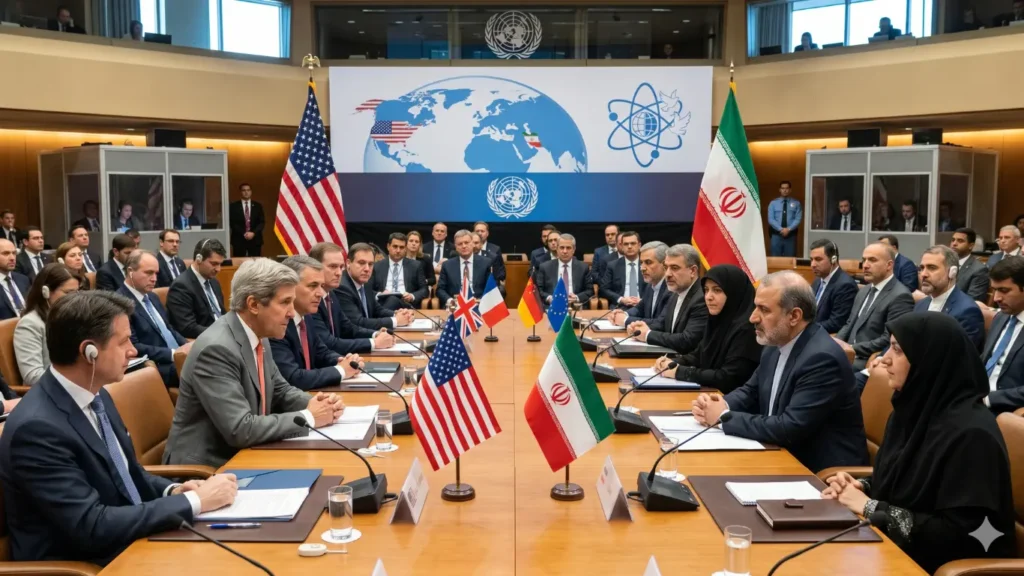
Few bilateral relationships have generated as dense a body of contemporary international legal practice as that between the United States and the Islamic Republic of Iran. Between June 2025 and February 2026, that relationship produced the collapse of the only operative non-proliferation framework binding Iran, the reactivation of United Nations sanctions through a contested “snapback” procedure, two waves of armed strikes against Iranian nuclear facilities, and the first concerted statement by more than one hundred international law experts that the United States had committed a manifest breach of Article 2(4) of the Charter. This paper examines those events through the prism of public international law, arguing that the unravelling of the JCPOA has not vindicated unilateralism but has instead exposed the structural fragility of the post-1945 framework governing the use of force and the law of treaties.
I. The JCPOA and Its Unravelling
The Joint Comprehensive Plan of Action of 14 July 2015, concluded between Iran and the P5+1 (China, France, Germany, Russia, the United Kingdom and the United States), constrained Iran’s uranium enrichment programme in exchange for the lifting of multilateral sanctions (Joint Comprehensive Plan of Action (Iran–P5+1) (adopted 14 July 2015, Vienna), annexed to UNSC Res 2231 (20 July 2015) UN Doc S/RES/2231). The agreement was endorsed unanimously by the Security Council in Resolution 2231 (2015), which transposed its principal provisions into binding measures under Chapter VII of the Charter and provided for their progressive expiry over a ten-year period culminating in “termination day” on 18 October 2025 (UNSC Res 2231 (n 1) paras 7–8 and Annex B).
On 8 May 2018, the United States announced its withdrawal from the JCPOA and reimposed the full architecture of pre-existing sanctions under its “maximum pressure” policy (Statement by President Donald J Trump on the Joint Comprehensive Plan of Action, The White House (8 May 2018); Kenneth Katzman, Iran Sanctions (Congressional Research Service Report RS20871, 2 February 2022)). Iran initially maintained compliance, but from May 2019 progressively reduced its undertakings, eventually enriching uranium to 60 per cent and, from February 2021, suspending implementation of the Additional Protocol. On 12 June 2025, the IAEA Board of Governors formally found Iran in non-compliance with its NPT safeguards agreement — the first such determination in two decades (Treaty on the Non-Proliferation of Nuclear Weapons (adopted 1 July 1968, entered into force 5 March 1970) 729 UNTS 161, art III; IAEA Board of Governors, ‘NPT Safeguards Agreement with the Islamic Republic of Iran’ (Resolution, 12 June 2025) GOV/2025/38).
II. The Snapback of UN Sanctions and Its Contested Legality
The dispute resolution mechanism in paragraphs 36 and 37 of the JCPOA, transposed into operative paragraphs 11–13 of Resolution 2231, permits any participant to refer a case of “significant non-performance” to the Security Council, with the consequence that previously terminated sanctions are reimposed unless the Council adopts a continuing resolution within thirty days (JCPOA (n 1) paras 36–37; UNSC Res 2231 (n 1) operative paras 11–13). On 28 August 2025, France, Germany and the United Kingdom (the “E3”) jointly invoked the mechanism, citing Iran’s sustained breaches (Letter dated 28 August 2025 from the Permanent Representatives of France, Germany and the United Kingdom to the United Nations addressed to the President of the Security Council, UN Doc S/2025/538). When no continuation resolution was adopted, the previously lifted measures — including the arms embargo, the prohibition on uranium enrichment-related activity, and asset freezes against listed entities — were reimposed automatically on 27 September 2025 (UN Department of Political and Peacebuilding Affairs, ‘Briefing on Resolution 2231 (2015)’ SC/16263 (23 December 2025); Council of the European Union, ‘Iran: EU reimposes nuclear-related restrictive measures’ (Press Release, 29 September 2025)). The reactivation rests on Article 41 of the Charter, under which the Council may decide “measures not involving the use of armed force” to give effect to its determinations (Charter of the United Nations (adopted 26 June 1945, entered into force 24 October 1945) 1 UNTS XVI, art 41).
Iran, China and the Russian Federation contest the lawfulness of the snapback. Their joint letter of 18 October 2025 argues that the E3 lacked standing to invoke the mechanism because they themselves had “ceased to perform” their JCPOA commitments by acquiescing in the United States’ unlawful withdrawal, and that the procedural prerequisites of the dispute resolution mechanism had not been exhausted (Iran, China and Russia, ‘Joint Letter to the President of the Security Council’ UN Doc S/2025/665 (18 October 2025); see also Daniel H Joyner, Iran’s Nuclear Program and International Law: From Confrontation to Accord (OUP 2016)). The dispute therefore raises difficult questions about the law of treaty performance, the privity of obligations under Council resolutions endorsing political agreements, and the legal effect of “termination day” on a process whose continuation depends on its non-expiry.
III. The June 2025 and February 2026 Strikes
On 13 June 2025, Israel commenced “Operation Rising Lion”, a sustained campaign of airstrikes against Iranian nuclear and military infrastructure, including the enrichment plants at Natanz and Fordow and the conversion facility at Isfahan. On 22 June 2025, the United States joined the operation by striking those same facilities with bunker-busting munitions. A second round of joint strikes followed on 28 February 2026. Article 2(4) of the Charter prohibits the threat or use of force against the territorial integrity or political independence of any State (UN Charter (n 8) art 2(4)), subject only to the inherent right of individual or collective self-defence under Article 51 in response to an armed attack and to enforcement action authorised by the Security Council (UN Charter (n 8) art 51; Military and Paramilitary Activities in and against Nicaragua (Nicaragua v United States of America) (Merits) [1986] ICJ Rep 14, paras 187–201).
Israel’s notification to the Security Council framed Operation Rising Lion as anticipatory self-defence against an “imminent” Iranian nuclear threat (Letter dated 17 June 2025 from the Permanent Representative of Israel to the United Nations addressed to the President of the Security Council, UN Doc S/2025/390). The argument is difficult to sustain. As Marko Milanović has observed, the operation’s stated objective was to “deflect a future armed attack” — the textbook formulation of preventive war, which falls outside any defensible reading of Article 51 (Marko Milanović, ‘Is Israel’s Use of Force Against Iran Justified by Self-Defence?’ (EJIL: Talk!, 13 June 2025) https://www.ejiltalk.org/is-israels-use-of-force-against-iran-justified-by-self-defence/ accessed 28 April 2026). Even on the most generous interpretation of the customary standard articulated in the Caroline correspondence — requiring a threat “instant, overwhelming, leaving no choice of means, and no moment for deliberation” — there was no Iranian armed attack imminent in June 2025: the United States and Iran were then engaged in active diplomatic negotiations, and the IAEA itself had reported no evidence of weaponisation (Letter from US Secretary of State Daniel Webster to British Minister Henry Fox (24 April 1841), in British and Foreign State Papers, vol 29 (1840–1841) 1129, 1138; Nicaragua (n 11) para 194).
On 1 April 2026, more than one hundred United States-based international law scholars — including the President of the American Society of International Law and former Legal Advisers to the Department of State — issued a joint statement concluding that the February 2026 strikes “clearly violated the United Nations Charter prohibition on the use of force”, and raised serious concerns under international humanitarian law concerning the targeting of nuclear scientists and the proportionality of attacks on facilities under IAEA safeguards (Tom Dannenbaum, Rebecca Hamilton, Adil Ahmad Haque, Oona A Hathaway and Gabor Rona, ‘Over 100 International Law Experts Warn: U.S. Strikes on Iran Violate UN Charter and May Be War Crimes’ (Just Security, 2 April 2026) https://www.justsecurity.org/135423/professors-letter-international-law-iran-war/ accessed 28 April 2026). The Secretary-General likewise warned that the strikes risked “catastrophic consequences” and undermined the non-proliferation regime as a whole (UN Secretary-General, ‘Statement on the Strikes against Iranian Nuclear Facilities’ (UN Press, 22 June 2025); Christine Gray, International Law and the Use of Force (4th edn, OUP 2018) 259–262).
IV. Sanctions, Countermeasures and State Responsibility
Beyond the use of force, the Iran file engages two further branches of public international law. The first concerns the lawfulness of unilateral economic sanctions. While the Charter does not prohibit such measures per se, they remain subject to the customary rules of state responsibility and to specific treaty regimes — most notably the 1955 Treaty of Amity, Economic Relations, and Consular Rights, on the basis of which Iran has secured significant rulings before the International Court of Justice (Treaty of Amity, Economic Relations, and Consular Rights between the United States of America and Iran (signed 15 August 1955, entered into force 16 June 1957) 284 UNTS 93; Legality of the Threat or Use of Nuclear Weapons (Advisory Opinion) [1996] ICJ Rep 226, para 105(2)(E)). In Certain Iranian Assets (2023), the Court found that several aspects of the United States’ secondary sanctions regime breached its treaty obligations and ordered reparation, although it declined to extend its jurisdiction to assets of the Iranian Central Bank (Articles on Responsibility of States for Internationally Wrongful Acts, in UNGA Res 56/83 (12 December 2001) UN Doc A/RES/56/83, Annex, arts 1, 31 and 49–50).
The second concerns the regime of countermeasures codified in the Articles on Responsibility of States for Internationally Wrongful Acts. Articles 49 and 50 ARSIWA permit a State injured by a wrongful act to take measures otherwise contrary to international law in order to induce compliance, subject to the requirements of necessity and proportionality (Antonios Tzanakopoulos, Disobeying the Security Council: Countermeasures against Wrongful Sanctions (OUP 2011) ch 7, esp 154–159). The framework is poorly suited to the Iran context: the United States invokes no specific Iranian wrongful act of which it is the immediate victim, and unilateral measures purporting to enforce non-proliferation norms have been criticised as exceeding the lawful scope of countermeasures and as encroaching upon the Council’s exclusive competence under Chapter VII (Certain Iranian Assets (Islamic Republic of Iran v United States of America) (Merits) Judgment of 30 March 2023, ICJ General List No 164 para 236(1),(3)-(8)).
V. Conclusion
The events of 2025 and 2026 have not produced a coherent legal settlement. The JCPOA is dead; UN sanctions have been reimposed by a contested procedure; armed force has been used twice against the territory of a State engaged in active diplomatic negotiations; and the IAEA has lost the ability to verify a programme it cannot inspect. The legal record now established confirms that the prohibition on the use of force, treaty integrity, and multilateral verification remain indispensable to any durable resolution of the Iranian nuclear question.
Baca juga: Rekognisi Carbon Credit Sebagai Efek: Implikasi Terhadap Rezim Hukum Jaminan di Indonesia